


What Is the Maximum Gooseneck Towing Capacity of the 2026 Chevrolet Silverado 2500HD?
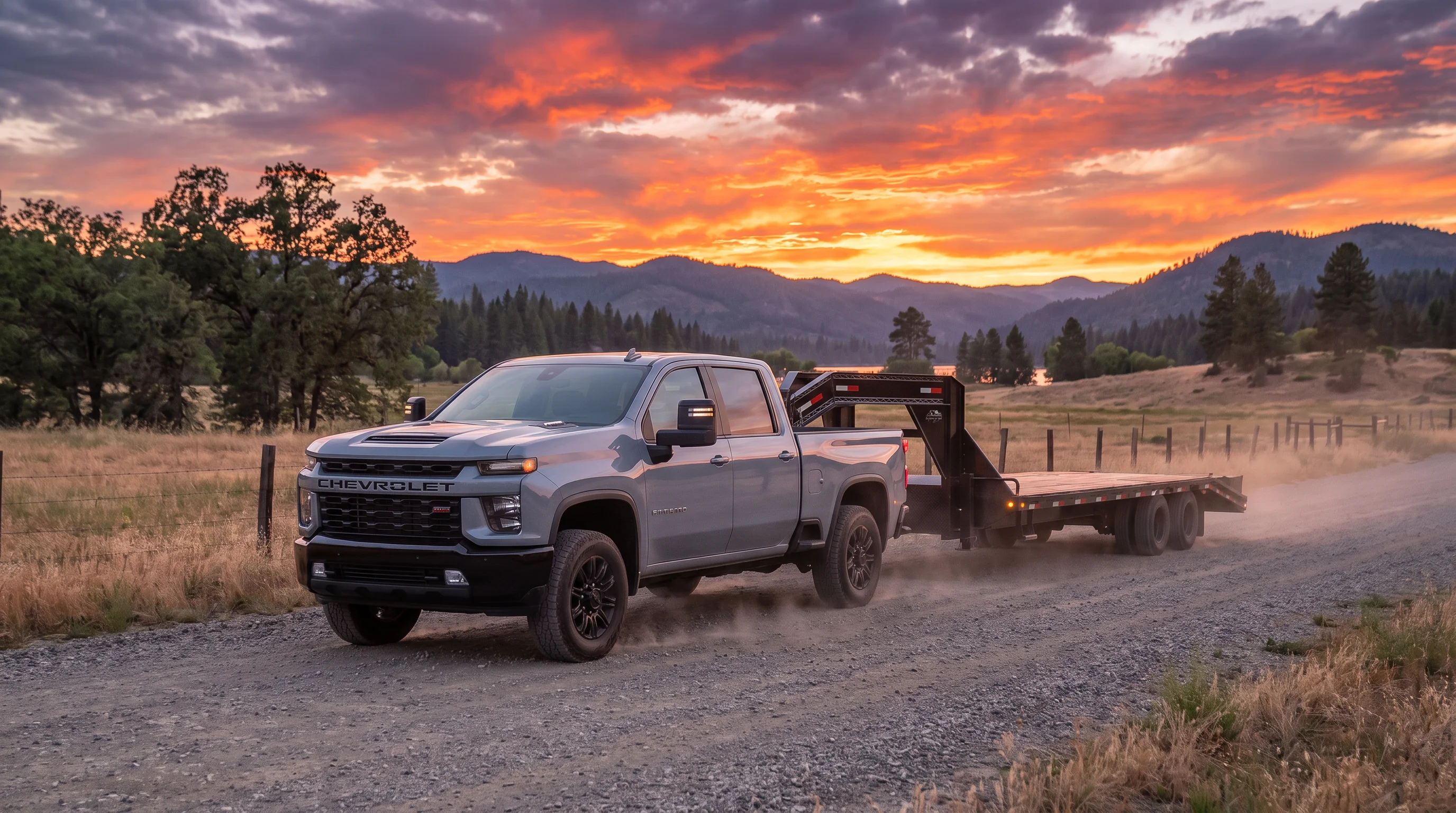
Properly equipped, the 2026 Chevrolet Silverado 2500HD is rated for up to 22,050 pounds of gooseneck and fifth-wheel trailering. Reaching that ceiling takes the available 6.6L Duramax Turbo-Diesel V8 and the Max Trailering Package. That combination raises the truck’s gross combination weight rating to 30,000 pounds. With the standard 6.6L V8 gas engine, maximum gooseneck trailering is 18,700 pounds.
Two packages get confused constantly, and the difference matters when you are speccing a truck. The Gooseneck/5th Wheel Prep Package puts the mounting hardware in the bed. The Max Trailering Package raises the rating. Reaching the top numbers takes both.
Conventional bumper-pull trailering on the 2500HD caps at 20,000 pounds. Moving to a gooseneck positions the trailer’s kingpin load near the rear axle centerline. That lets the truck work against its full gross combination weight rating instead of the leverage limits of a rear-mounted receiver. For heavy equipment, multi-horse trailers, or large fifth-wheel RVs, that geometry is what unlocks the higher number.
Ratings also shift with cab, bed, drivetrain, and wheel size. The figure printed on your truck’s door-jamb label is the one that governs your specific vehicle. Full ratings by configuration are published in Chevrolet’s 2026 Trailering Guide.
To walk through spec sheets or check trailer fitment in person, stop by our showroom on US-287 Bypass or call our heavy-duty truck specialists.
How Does a Gooseneck Hitch Work on a Silverado 2500HD?
A gooseneck hitch mounts a 2-5/16-inch ball inside the truck bed, positioned so the kingpin load sits near the rear axle centerline. Chevrolet is specific that the hitch must attach to the truck frame, and that the pickup bed must not be used for additional support.
Why Load Position Changes What the Truck Can Pull
Unlike a receiver hitch bolted at the rear bumper, placing the load over the rear axle reduces lever-arm torque on the frame. Bumper-pull trailers lever the rear of the truck downward, lifting the front axle and lightening the steering. A gooseneck coupling presses down between the front and rear wheels instead, keeping weight distributed across all four tires. That vertical load, called pin or kingpin weight, keeps steering geometry stable and preserves front tire grip under acceleration and hard braking.
Tighter Turning in Close Quarters
The position also improves maneuverability. The pivot point sits inside the bed rather than behind the bumper. That lets a gooseneck trailer swing to much sharper angles relative to the cab during low-speed maneuvers. Tight staging areas, gates, and cul-de-sacs get far easier to work than they are with an equivalent bumper-pull rig.
For drivers around Midlothian, that extra maneuverability shows up every time you thread a narrow entrance. You can browse our new Silverado 2500HD inventory to see which bed configurations are on the ground.
What Comes in the Factory Gooseneck/5th Wheel Prep Package?
Chevrolet describes the Gooseneck/5th Wheel Prep Package as a hitch platform ready to accept a gooseneck ball or fifth-wheel hitch. The package also brings a box-mounted trailer harness, a spray-on bedliner, and all the necessary box and bedliner holes drilled and capped. It requires a bumper hitch and is not available with the pickup bed delete.
Because the structure is built in during assembly, there is nothing to measure, drill, or bolt through the bed floor later. With the ball and chain anchors removed, the bed sits flat for gravel, lumber, or gear.
Hitch Platform
An under-bed platform ready to accept a gooseneck ball or a fifth-wheel hitch.
Capped Bed Openings
Box and bedliner holes drilled and capped at the factory, so the bed floor stays sealed when the hardware is out.
Box-Mounted Trailer Harness
Keeps the trailer connection inside the bed instead of draped over the tailgate.
Spray-On Bedliner
Included with the package and applied around the bed openings.
One clarification worth making: the ball and safety chain anchors are not part of the prep package. Those come in a separate gooseneck ball and chain tie-down kit. The prep package is the structure. The kit is the hardware.
If you want a truck that already has this setup, check our used truck inventory. The factory package cannot be added later, so a used truck either has it or it does not.
How Engine, Cab, Bed Length, and Pin Weight Affect Your Rating
Engine choice, cab configuration, bed length, and pin weight together set what a given 2500HD can actually pull on a gooseneck.
Engine Choice Sets the Ceiling
| Engine | Horsepower | Torque | Max Conventional | Max Gooseneck / 5th-Wheel |
|---|---|---|---|---|
| 6.6L V8 Gas (standard) | 401 hp | 464 lb-ft | 16,000 lbs | 18,700 lbs |
| Duramax 6.6L Turbo-Diesel V8 (available) | 470 hp | 975 lb-ft | 20,000 lbs | 22,050 lbs |
Maximum towing and payload capacity figures are based on properly equipped vehicles and vary by configuration. Do not exceed any weight rating. See your owner’s manual and the vehicle’s door-jamb label for specific capacities.
Engine output is published on the Chevrolet Silverado HD model page. Trailer weight ratings come from Chevrolet’s 2026 Silverado 2500 HD trailering chart.
Cab and Bed Change the Number More Than Most Shoppers Expect
Curb weight comes out of capacity, so the cab and bed you choose move the rating by more than a thousand pounds. Every configuration below carries the Duramax and the Max Trailering Package with 18- or 20-inch wheels. That is what it takes to reach the top of the range.
| Configuration | Drivetrain | GVWR | GCWR | Max Gooseneck / 5th-Wheel |
|---|---|---|---|---|
| Regular Cab, Long Bed | 4×4 | 11,450 lbs | 30,000 lbs | 22,050 lbs |
| Double Cab, Long Bed | 4×4 | 11,450 lbs | 30,000 lbs | 22,050 lbs |
| Crew Cab, Standard Bed | 4×4 | 11,750 lbs | 30,000 lbs | 21,600 lbs |
| Crew Cab, Standard Bed | 2WD | 11,500 lbs | 30,000 lbs | 21,510 lbs |
| Crew Cab, Long Bed | 4×4 | 11,900 lbs | 30,000 lbs | 21,490 lbs |
Maximum towing and payload capacity figures are based on properly equipped vehicles and vary by configuration. Do not exceed any weight rating. See your owner’s manual and the vehicle’s door-jamb label for specific capacities.
The pattern is consistent: the lighter the cab, the more capacity is left over for the trailer. Regular Cab and Double Cab Long Bed models reach the 22,050-pound ceiling. Crew Cab models give up roughly 450 to 560 pounds of it in exchange for the second row.
Bed Length and Turning Clearance
Bed length changes turning clearance. An 8-foot long bed leaves generous room between the trailer nose and the back of the cab in a sharp turn. The 6.75-foot standard bed parks more easily, but a wide gooseneck trailer needs watching in a jackknife turn unless you run an offset ball.
Pin Weight Comes Out of Payload
Pin weight is where most people get caught. Chevrolet’s guidance is that gooseneck or fifth-wheel kingpin weight should be 15 to 25 percent of the total loaded trailer weight. Every pound of it counts against payload rather than towing capacity. It also cannot push the truck past its rear axle rating or its gross vehicle weight rating.
| Hitch Type | Recommended Tongue or Pin Weight | Maximum at Full Trailer Weight |
|---|---|---|
| Conventional bumper-pull | 10% to 15% of loaded trailer weight | 10% |
| Gooseneck / fifth-wheel | 15% to 25% of loaded trailer weight | 15% |
Contractors running into work sites from DeSoto have to balance that pin load against passengers and bed cargo to stay inside the rear axle rating.
What Are the Essential Steps to Tow a Gooseneck Trailer Safely?
Six things matter: your weight ratings, the coupling hardware, how the load sits, the electrical connection, and how you drive once you are rolling.
- Verify your weight ratings. The Trailering Information Label on the driver-side door jamb lists your truck’s GVWR, GCWR, rear axle rating, maximum payload, maximum tongue weight, and curb weight. Compare your trailer against those numbers, not against a brochure maximum.
- Couple to the ball. Lower the trailer coupler onto the 2-5/16-inch gooseneck ball, confirm the locking latch closes completely, and insert the safety pin.
- Attach the safety chains. Chevrolet calls for safety chains on gooseneck as well as conventional hitches, with just enough slack for the combination to turn. Do not let the chains drag on the ground. Connect the breakaway switch cable to a secure point on the truck.
- Load for balance. With the trailer axles centered, Chevrolet’s rule of thumb is to put about 60 percent of the load over the front half of the trailer and distribute it evenly side to side. Loads too far forward or too far back invite trailer sway at highway speed and under heavy braking. Secure everything before you move.
- Run the electrical check. Connect the in-bed trailer harness, verify brake lights, turn signals, and running lights, then set your trailer brake controller gain.
- Set up and drive. Extend the trailering mirrors and engage Tow/Haul Mode. For following distance, Chevrolet’s measure is one vehicle-and-trailer length for every 10 mph of speed. Brake earlier than normal before a corner, then swing wide so both truck and trailer clear the inside of the turn.
Chevrolet’s full pre-trip and on-road trailering guidance is published in the 2026 Trailering Guide.
Can You Add a Gooseneck Hitch After You Buy the Truck?
Yes and no, and the distinction is the most important thing on this page.
The Factory Package Is Order-Time Only
The factory Gooseneck/5th Wheel Prep Package cannot be added after the truck leaves the plant. The under-bed structure is welded to the frame during assembly, so a truck either left the factory with the in-bed mounting points or it did not. The OEM under-bed hitch assembly is likewise designed only for trucks that already have the factory prep package.
The Aftermarket Path
What can be added is an aftermarket under-bed gooseneck hitch. Manufacturers build bolt-in assemblies that mount to the frame rails beneath the bed. Installation involves dropping the spare tire, positioning the crossmembers, cutting access openings for the ball and safety chains, and running the bed-wall wiring.
The Ball and Chain Kit
Chevrolet also sells a gooseneck ball and chain tie-down kit for trucks that already have the factory prep platform. It includes a 2-5/16-inch gooseneck ball with a ball-bearing quick-release locking mechanism and two safety chain anchors that drop into the outer bed pucks. A storage case and rubber bed-opening covers round out the kit.
The practical takeaway when you are shopping: if gooseneck towing is in your future, decide before you order. Adding the factory package later is not an option. You can compare configurations on our 2026 Silverado 2500HD trim levels and pricing page.
Common Questions About Silverado 2500HD Gooseneck Towing
How much pin weight does a gooseneck trailer put on a 2500HD?
Chevrolet’s guidance is that gooseneck or fifth-wheel kingpin weight should run 15 to 25 percent of the total loaded trailer weight, and that when you are towing the maximum rated trailer weight, the maximum kingpin weight is 15 percent. That downward load counts against payload, not towing capacity, so it competes directly with passengers, fuel, and anything in the bed. It also cannot push the truck past its rear gross axle weight rating or its gross vehicle weight rating, which is why the door-jamb label rather than a brochure maximum is the number to work from.
Do I need an offset hitch ball for a standard-bed 2500HD?
The 6.75-foot standard bed is easier to park, but tight turns with a wide gooseneck trailer can bring the trailer nose close to the cab. An offset gooseneck ball moves the coupling point rearward, commonly four or five inches depending on the manufacturer, which buys clearance without any structural modification. An 8-foot long bed provides that clearance without an offset ball.
How does Tow/Haul Mode help with a heavy gooseneck trailer?
Tow/Haul Mode is standard on Silverado HD. It adjusts the shift schedule in the automatic transmission so it is not hunting for the correct gear while towing. Tow/Haul Mode Grade Braking is included as well, using the engine and transmission to help hold your speed on downhill grades. On Duramax trucks, the Diesel Exhaust Brake works with Tow/Haul Mode and auto grade braking, using a variable vane geometry turbo to create back pressure that slows the truck and reduces brake use.
What driver-assist technology helps when backing up to a gooseneck ball?
For gooseneck and fifth-wheel work, the relevant feature is Bed View with Hitch Guidance, which shows the cargo bed so you can line the coupler up over the ball, with Cargo Bed Zoom for a closer look. Hitch View, by contrast, is aimed at conventional receiver hitches. Silverado HD offers up to 14 unique views from eight available cameras, and Hitch Guidance is standard on Silverado HD. Silverado HD models also offer an Enhanced Transparent Trailer View for fifth-wheel and gooseneck trailers, which requires an available Chevrolet Accessory trailer camera. The In-Vehicle Trailering App stores custom trailer profiles and runs a pre-departure checklist.
Driver-assistance and advanced safety systems are supplemental aids and are not substitutes for safe and attentive driving. Availability, operation, and effectiveness vary by trim and equipment and depend on factors including road, weather, traffic, and vehicle condition. Always keep your hands on the wheel and your eyes on the road. See your owner’s manual for system limitations and details.
Does towing a heavy gooseneck trailer in Texas require a special license?
It can. The Texas Department of Public Safety requires a Class A when the combined gross vehicle weight rating of the truck and trailer is 26,001 pounds or more and the trailer alone is rated above 10,000 pounds GVWR. That test uses rated weights, not what the rig actually scales at, and Texas draws a distinction between commercial and non-commercial classifications. Because 2500HD gross vehicle weight ratings vary by configuration and trailer ratings vary widely, check your specific numbers against the Texas DPS license classification guidance before you hook up.
Heavy-Duty Gooseneck Towing at Legacy Chevrolet of Waxahachie
Matching the truck to the heaviest load you actually pull is where this starts. The 2026 Silverado 2500HD is rated for up to 22,050 pounds of gooseneck trailering. Getting there takes the Duramax 6.6L Turbo-Diesel V8, the 10-speed Allison automatic transmission, and the Max Trailering Package. The Gooseneck/5th Wheel Prep Package supplies the bed hardware to go with it.
Whether you haul livestock, equipment, or a large fifth-wheel, our team can walk you through which cab, bed, and package combination gets you there. Stop by 1701 US-287 Bypass in Waxahachie to see factory gooseneck prep in person. You can drive a heavy-duty truck and go through the ratings with a specialist.
Disclaimers
Maximum towing and payload capacity figures are based on properly equipped vehicles and vary by configuration. Do not exceed any weight rating. See your owner’s manual and the vehicle’s door-jamb label for specific capacities.
Driver-assistance and advanced safety systems are supplemental aids and are not substitutes for safe and attentive driving. Availability, operation, and effectiveness vary by trim and equipment and depend on factors including road, weather, traffic, and vehicle condition. Always keep your hands on the wheel and your eyes on the road. See your owner’s manual for system limitations and details.
0 comment(s) so far on What Is the Maximum Gooseneck Towing Capacity of the 2026 Chevrolet Silverado 2500HD?