


2026 Chevy Traverse vs. 2026 Ford Explorer: Which Three-Row SUV Fits Your Waxahachie Family?
The 2026 Chevrolet Traverse delivers what families actually need from a three-row SUV: 328 horsepower, best-in-class cargo space up to 98 cubic feet, seating for up to eight, and a segment-leading 17.7-inch touchscreen — all backed by 5,000-lb towing capability. The 2026 Ford Explorer competes in the same midsize three-row segment starting at a lower $38,465 MSRP, but that entry price comes with less power, less cargo room, and a smaller screen. The Explorer does offer an available V6 at the top of its lineup and slightly better estimated highway fuel economy.
Below, we compare the two across pricing, powertrain, space, fuel economy, technology, safety, and warranty so you can see where each SUV earns its price tag — and where the Traverse pulls ahead for Ellis County families.
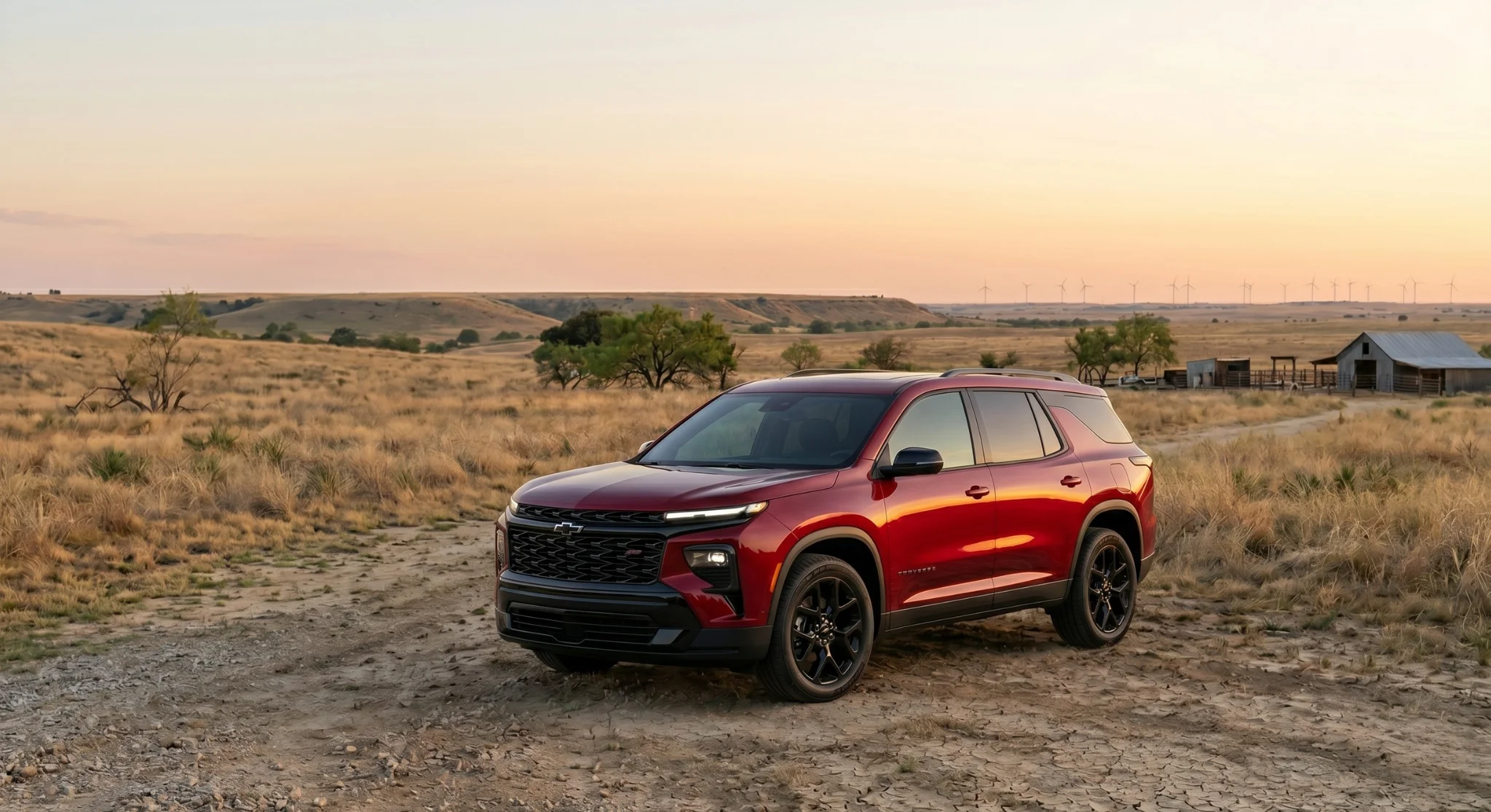
Pricing at a Glance
| 2026 Chevrolet Traverse | 2026 Ford Explorer | |
|---|---|---|
| Starting MSRP | $42,695 (LT FWD) | $38,465 (Active 100A) |
| Top trim starting MSRP | $57,295 (RS FWD) | $56,700 (ST) |
| Trim count | 4 (LT, Z71, High Country, RS) | 6 (Active 100A, Active, ST-Line, Tremor, Platinum, ST) |
Adding all-wheel drive to either SUV costs an additional $2,000 on most trims. Traverse AWD pricing by trim:
- LT: $42,695 FWD / $44,695 AWD
- Z71: $50,795 AWD standard
- High Country: $56,995 FWD / $58,995 AWD
- RS: $57,295 FWD / $59,295 AWD
The Explorer’s lower sticker comes with context: its $38,465 Active 100A is a new-for-2026 stripped-down entry trim that didn’t exist last year. The comparably equipped Explorer Active starts at $40,260 — narrowing the gap with the Traverse LT to roughly $2,400. At that spread, the Traverse LT already includes a larger engine (328 hp vs. 300 hp), a bigger touchscreen (17.7 inches vs. 13.2 inches), more cargo space, and seating for up to eight. At the top of each lineup, pricing is comparable — the Traverse RS and Explorer ST both reach the upper $50,000s. The Traverse’s four-trim structure keeps the lineup focused, while each trim delivers more standard content than its Explorer counterpart at a similar price point.
Powertrain & Performance
| Specification | 2026 Chevy Traverse | 2026 Ford Explorer |
|---|---|---|
| Engine | 2.5L Turbo 4-cylinder | 2.3L EcoBoost I-4 (3.0L V6 available) |
| Horsepower | 328 hp | 300 hp (400 hp with V6) |
| Torque | 326 lb-ft | 310 lb-ft (415 lb-ft with V6) |
| Transmission | 8-speed automatic | 10-speed automatic |
| Drivetrain | FWD standard, AWD available | RWD standard, Intelligent 4WD available |
| Max Towing | 5,000 lbs | 5,000 lbs |
The Traverse’s turbocharged 2.5L produces 328 hp and 326 lb-ft of torque on every trim — 28 more horsepower and 16 more lb-ft than the Explorer’s standard 2.3L EcoBoost. That power advantage is standard equipment, not an upcharge. Both SUVs tow up to 5,000 pounds when properly equipped, so for Ellis County families pulling a boat to Lake Bardwell or hauling a utility trailer, the Traverse matches the Explorer’s towing while delivering noticeably stronger acceleration for merging onto I-35 and passing on two-lane roads.
The Explorer does offer an available 3.0L twin-turbo V6 with 400 hp on the ST ($56,700+) and Tremor trims, but that upgrade pushes the price well past the Traverse’s entire lineup. For the vast majority of three-row SUV shoppers, the Traverse’s standard powertrain delivers the performance families need without the premium price tag.
Size, Seating & Cargo
| Specification | 2026 Chevy Traverse | 2026 Ford Explorer |
|---|---|---|
| Seating | 7 or 8 | 6 or 7 |
| Length | ~204 in | 198.7 in |
| Wheelbase | 121.0 in | 119.1 in |
| Cargo behind 3rd row | 22.9 cu ft | 16.3 cu ft |
| Cargo behind 2nd row | 56.6 cu ft | 46.0 cu ft |
| Maximum cargo | 97.6 cu ft | 85.8 cu ft |
The Traverse is roughly 5 inches longer than the Explorer with a 2-inch wheelbase advantage, and that extra length translates directly into passenger and cargo space. The Traverse seats up to eight with the available second-row bench on the LT trim; Z71, RS, and High Country seat seven with standard captain’s chairs. The Explorer seats six or seven depending on configuration.
Cargo is where the Traverse pulls ahead decisively. Behind the third row with all seats in place, the Traverse offers 22.9 cubic feet versus the Explorer’s 16.3 — roughly 40% more trunk space for everyday use. Fold the third row and the gap widens to 56.6 versus 46.0 cubic feet. Maximum cargo with all rear seats folded reaches 97.6 cubic feet in the Traverse versus 85.8 in the Explorer. For Waxahachie families hauling sports equipment, strollers, groceries, and weekend gear, the Traverse’s cargo advantage is tangible at every configuration.
Fuel Economy
| Specification | 2026 Chevy Traverse (FWD) | 2026 Ford Explorer (2.3L RWD) |
|---|---|---|
| EPA-Estimated City MPG | 20 | 20 |
| EPA-Estimated Highway MPG | 26 | 29 |
| EPA-Estimated Combined MPG | 22 | 24 |
The Explorer holds a modest fuel economy edge — an EPA-estimated 24 mpg combined versus the Traverse’s estimated 22 mpg in base drivetrain configurations, with a 3-mpg gap on the highway (an estimated 29 vs. 26). The Explorer’s 10-speed transmission and lighter curb weight contribute to the difference. In practical terms, that estimated 2-mpg combined gap amounts to roughly $200–$300 per year over 15,000 miles at current Texas gas prices — a difference that narrows quickly against the Traverse’s advantages in power, cargo space, and standard equipment.
With all-wheel drive, both SUVs see modest drops in estimated fuel economy:
- Traverse AWD: EPA-estimated 20 city / 24 highway / 21 combined
- Explorer 4WD (2.3L): EPA-estimated 20 city / 27 highway / 23 combined
For a Waxahachie commuter driving regularly to the DFW metroplex, the fuel cost difference between an estimated 22 and 24 mpg combined is noticeable over a long ownership cycle but far from decisive — especially when the Traverse delivers 28 more horsepower, nearly 12 more cubic feet of usable cargo behind the third row, and a screen 4.5 inches larger at every trim level. The Explorer’s available 3.0L V6 drops efficiency further to an estimated 18/25/21 (RWD), so V6 buyers pay a significant fuel penalty on top of the higher trim price.
Technology
The Traverse comes standard on every trim with a 17.7-inch diagonal infotainment touchscreen, an 11-inch driver information center, Google Built-in (Maps, Assistant, Play Store), wireless Apple CarPlay and Android Auto, and standard wireless smartphone charging. A six-speaker audio system is standard; an available Bose premium audio system upgrades the listening experience. A 5G Wi-Fi hotspot is offered. Available Super Cruise hands-free highway driving comes standard on RS and High Country trims and is available on LT and Z71 through the Enhanced Driving Package.
The Explorer features a 13.2-inch touchscreen, a 12.3-inch digital instrument cluster, and an Android-based infotainment system with wireless Apple CarPlay and Android Auto. An available Bang & Olufsen premium audio system is offered on higher trims. BlueCruise hands-free highway driving is available on ST-Line and above. Note: Ford deleted the wireless charging pad across the entire 2026 Explorer lineup.
The Traverse holds a clear technology advantage. Its 17.7-inch touchscreen is over 4 inches larger than the Explorer’s 13.2-inch unit — a difference you notice immediately from the driver’s seat. Both SUVs offer hands-free highway driving (Super Cruise on the Traverse, BlueCruise on the Explorer) and wireless phone connectivity. Where the Traverse pulls further ahead: Ford deleted wireless charging entirely from the 2026 Explorer lineup, while the Traverse includes it as standard equipment on every trim. Combined with Google Built-in integration, the Traverse delivers a more complete technology package at every price point.
Safety
Every 2026 Traverse includes Chevy Safety Assist standard across all trims: Automatic Emergency Braking, Front Pedestrian and Bicyclist Braking, Lane Keep Assist with Lane Departure Warning, Forward Collision Alert, Following Distance Indicator, and IntelliBeam automatic high beams. The Traverse also comes standard with Adaptive Cruise Control, blind spot monitoring, rear cross-traffic alert, and rear parking sensors on every trim. The available Driver Confidence Package ($1,225 on LT and Z71, standard on RS and High Country) adds Blind Zone Steering Assist with active steering correction, a rear camera mirror, and Rear Automatic Braking.
The 2026 Ford Explorer comes standard with Ford Co-Pilot360 Assist+, including Pre-Collision Assist with Automatic Emergency Braking, Blind Spot Information System with Cross-Traffic Alert, Lane-Keeping System, and Adaptive Cruise Control with Stop-and-Go. A 360-degree camera system is available on higher trims.
Both vehicles offer strong standard safety technology. The Traverse comes standard with adaptive cruise control, automatic emergency braking, blind spot monitoring, rear cross-traffic alert, and lane-keeping assistance on every trim — a comprehensive suite without requiring packages or upgrades. The Explorer bundles similar core technology through its Co-Pilot360 Assist+ package. For hands-free highway driving, the Traverse offers available Super Cruise and the Explorer offers available BlueCruise — both capable systems for long highway drives between Waxahachie and the DFW metroplex.
Warranty
Both Chevrolet and Ford offer the same core warranty structure: 3-year / 36,000-mile bumper-to-bumper coverage, 5-year / 60,000-mile powertrain coverage, and 5-year / 60,000-mile roadside assistance. Corrosion coverage differs slightly: Chevrolet provides 3-year / 36,000-mile corrosion protection plus 6-year / 100,000-mile rust-through coverage, while Ford provides 5-year / unlimited-mile corrosion coverage. In practical terms, the two warranties are comparable and both transfer to subsequent owners.
Verdict: Which Three-Row SUV Fits Your Waxahachie Life?
The 2026 Chevy Traverse delivers:
- More standard horsepower — 328 hp vs. 300 hp on every trim, no upcharge required
- Best-in-class cargo space at every configuration — 22.9 cu ft behind the third row, 56.6 behind the second row, and 97.6 cu ft maximum
- Seating for up to eight passengers versus the Explorer’s seven
- A 17.7-inch touchscreen that dwarfs the Explorer’s 13.2-inch display
- Available Super Cruise hands-free driving and standard wireless charging — the Explorer deleted wireless charging entirely for 2026
- Equal 5,000-lb towing capacity with a standard trailering package
The Explorer may suit you if:
- A lower starting price is the primary factor — the stripped-down Active 100A starts at $38,465
- You prioritize estimated highway fuel economy (an estimated 29 vs. 26 mpg highway)
- You specifically want a V6 engine option (400 hp, available on ST and Tremor only)
For most Waxahachie families, the Traverse is the stronger choice. It delivers more power, more space, more technology, and more passenger capacity than the Explorer — the categories that matter most in a family SUV. The Explorer’s advantages are real but narrower: a lower entry price on a trim with fewer features, and an estimated 2-mpg fuel economy edge that amounts to a few hundred dollars a year. When you’re choosing the SUV your family will live in for the next five to seven years, the Traverse’s everyday advantages add up to a better ownership experience.
Common Questions
Which has more cargo space, the Traverse or the Explorer?
The Traverse leads in every cargo configuration. Behind the third row, the Traverse offers 22.9 cu ft versus 16.3 cu ft in the Explorer. Behind the second row, the gap widens to 56.6 vs. 46.0 cu ft. Maximum cargo capacity with all seats folded is 97.6 cu ft in the Traverse versus 85.8 cu ft in the Explorer.
Which has better fuel economy for daily commuting?
The Explorer holds a slight edge at an EPA-estimated 24 mpg combined (RWD, 2.3L) versus the Traverse’s estimated 22 mpg combined (FWD). That estimated 2-mpg gap translates to roughly $200–$300 per year in fuel costs over 15,000 miles — a modest difference compared to the Traverse’s advantages in power (328 vs. 300 hp), cargo space, and standard technology.
How does towing compare between the two?
Both the 2026 Traverse and 2026 Explorer tow up to 5,000 pounds when properly equipped. Towing capacity is identical across both lineups. The Traverse includes a standard trailering package with a heavy-duty cooling system and Hitch View camera integration.
Which SUV has more horsepower?
The Traverse wins on standard power — its 2.5L turbo produces 328 hp and 326 lb-ft on every trim, compared to the Explorer’s 300 hp and 310 lb-ft from its standard 2.3L. The Explorer offers an available 3.0L V6 with 400 hp, but only on the ST ($56,700+) and Tremor trims, pushing the price well above the Traverse’s range for most families.
Ready to See the Traverse in Person?
Legacy Chevrolet of Waxahachie stocks the 2026 Traverse lineup — LT, Z71, High Country, and RS — in both FWD and AWD configurations. Visit us at 1701 US-287 Byp, Waxahachie, TX 75165 or call (972) 268-6126 to schedule a test drive.
0 comment(s) so far on 2026 Chevy Traverse vs. 2026 Ford Explorer: Which Three-Row SUV Fits Your Waxahachie Family?